The Exposure Triangle

The exposure triangle is the 80% of photography you can learn from just a few basic principles. The “triangle” refers to the 3 main exposure settings on the camera. Aperture, Shutter Speed, and ISO. Each of them controls how much light is captured in your image, and each has some secondary effects on how the image looks. The goal is to capture just the right amount of light so we don’t get too much or too little light in any part of the resulting image.
Bucket Analogy
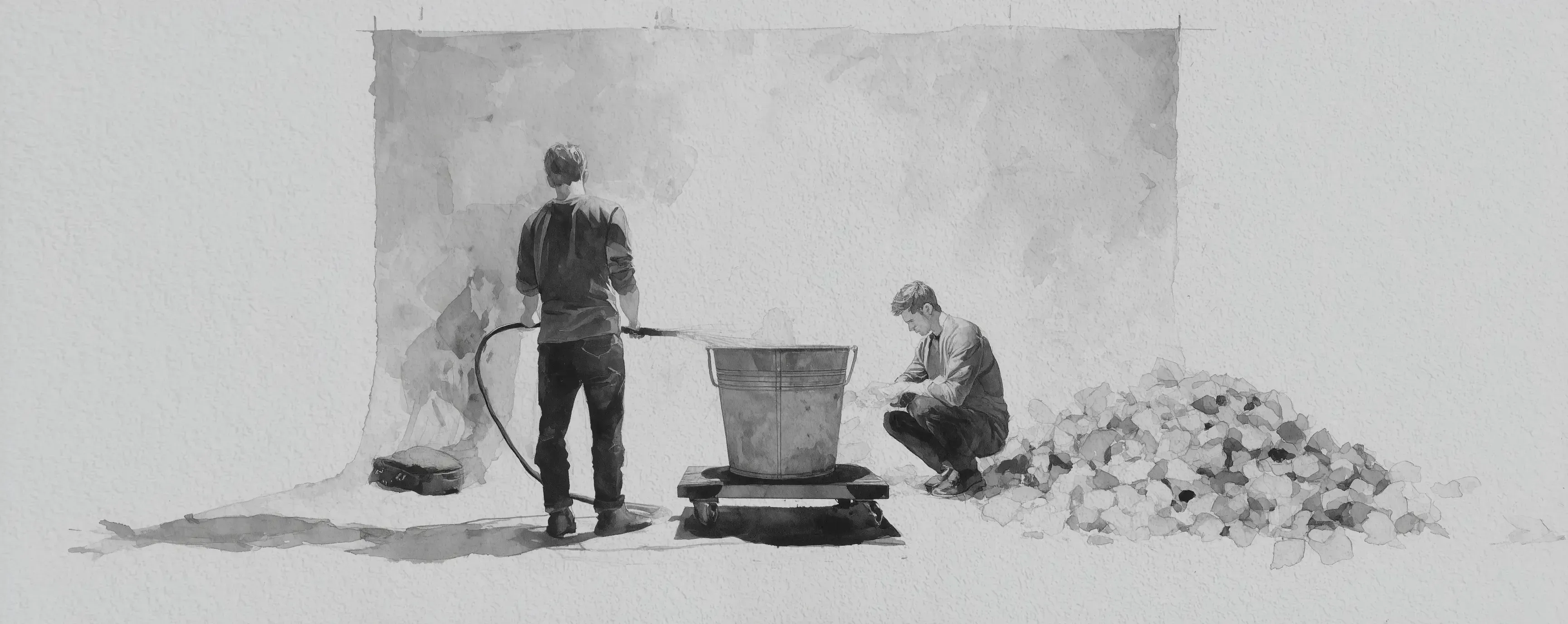
Let’s keep this simple first. Imagine your camera sensor is a bucket on a scale, and your goal is to make it weigh exactly 2 pounds by adding water.
- The water represents light
- The final weight of 2 pounds represents correct exposure
You have three controls that determine how much water ends up in the bucket. If we fill the bucket too much it could overflow and if we don’t fill it enough… well we might just end up with no water in the bucket.
Aperture: Size of the Hole
Assume that we will spray water for 10 seconds. Our bucket has a hole at the top that we can make larger or smaller. If we choose the perfect size for the hole through trial and error we can achieve our target weight of 2 pounds with the 10 seconds of spraying.
This is how aperture works in the camera, we can change the size of the opening to let more or less light into our camera.
Shutter Speed: How Long You Spray
Now imagine we leave the hole on top completely open. Now the only option we have to control the ending weight is to spray the water for less time. We can determine that 5 seconds of spray time to reach our target of 2 pounds.
This is how shutter speed works in the camera. We can choose how long we want to allow light into the camera for.
ISO: Adding Rocks
Now imagine we only have a small amount of water left to spray, so we can only spray for 2 seconds, but the hole on top of the bucket is already all the way open. Even if we spray for our full 2 seconds the bucket won’t reach 2 pounds.
This is where the rocks come in, we can add rocks to add weight without counting on the water.
- Rocks increase the starting weight
- Downside = the rocks make the water dirty.
Our goal is to use as few rocks as possible to keep the water clean but make sure our 2 seconds of water makes us reach our target weight.
This is how ISO works on our camera! ISO doesn’t add light, it just amplifies the light that we will capture. The tradeoff is the more amplification we have, the more noise becomes visible in our image.
Bucket Analogy Conclusion
By using our 3 variables: hole size (aperture), spray duration (shutter speed), and starting weight (ISO) we could find a way to achieve our target weight in all kinds of different conditions with any different amounts of water. Sounds easy right?
This is where things get more interesting. The settings have some secondary side effects to consider.
Aperture
The aperture is a set of blades in your lens that opens or closes to let more or less light in.
Other Effects of Aperture
Depth of Field is the primary consequence of aperture besides how much light hits the sensor. With a wide aperture (the blades all the way open) we will end up with a shallow depth of field. With a narrow aperture (blades almost all the way closed) we will end up with a deeper depth of field.
[insert some sort of chart or illustration to show how depth of field works with aperture]
How Aperture is Measured
We measure aperture as a ratio between the focal length of the lens to the size of the aperture opening.
- Example: f/2.8
- Example: f/11
If our lens has a 50mm focal length, and our aperture is f/2, that means our aperture opening is 25mm in diameter (50/2). If we use the same lens with a 50mm focal length and aperture is set to f/10, that means our opening would be 5mm in diameter (50/10).
Shutter Speed
The shutter is a physical mechanism in the camera that opens and closes in front of the sensor. Shutter speed controls how long we expose the sensor to light.
Other Effects of Shutter Speed
Motion blur (or lack of it) is the primary consequence of shutter speed besides how much light reaches the sensor.
With a fast shutter speed, moving subjects are frozen in place because the sensor is only exposed for a very short moment. With a slow shutter speed, motion is recorded over time, which can result in motion blur or light trails from moving subjects.
[insert some sort of chart or illustration showing fast vs slow shutter speed and motion blur]
How Shutter Speed Is Measured
Shutter speed is measured in seconds or fractions of a second.
- Example: 1/1000 of a second
- Example: 1/250th
- Example: 1/60
- Example: 1" (one second)
A shutter speed of 1/1000 means the shutter is open for one one-thousandth of a second, allowing very little light to reach the sensor. A shutter speed of 1/60 keeps the shutter open much longer, allowing significantly more light to accumulate.
Pro Tip
Unless you’re taking photos of something moving quickly, or you’re looking to intentionally create motion blur, speeds like 1/125 or 1/250 are great starting points to prevent unintended motion blur while letting the most light in.
ISO
ISO controls how sensitive the camera’s sensor is to light. Unlike aperture and shutter speed, ISO does not change how much light enters the camera. Instead, it adjusts how strongly the sensor’s signal is amplified after light has already hit it.
Other Effects of ISO
Image noise is the primary consequence of ISO besides image brightness.
With a low ISO value, images appear clean and smooth because very little signal amplification is applied. As ISO increases, the sensor’s signal is amplified more aggressively, which also amplifies unwanted electrical noise. This results in grain, color speckling, and a loss of fine detail.
[insert some sort of chart or illustration showing low ISO vs high ISO noise]
How ISO Is Measured
ISO is measured as a numerical value that represents sensor sensitivity.
- Example: ISO 100
- Example: ISO 400
- Example: ISO 1600
- Example: ISO 6400
Each doubling of the ISO value roughly doubles the brightness of the image. For example, ISO 200 is twice as sensitive as ISO 100, and ISO 400 is twice as sensitive as ISO 200. While higher ISO values make it easier to shoot in low light, they do so at the cost of increased noise and reduced image quality. More capable and expensive cameras can handle high ISO better than older ones, but the tradeoff never disappears.
Pro Tip
Increasing exposure when editing the image is very similar to increasing your ISO, it will also increase the amount of noise that is visible. The noise is always there, increasing your ISO or exposure in post reveals it.
As such, shooting your photo really underexposed to avoid ISO then raising exposure will not result in less noise. Actually it will usually result in more noise because the camera is better at processing high signal than our editing apps.
Conclusion
The exposure triangle explains how aperture, shutter speed, and ISO work together to control light and shape the look of an image. Each setting affects exposure, but each also comes with its own tradeoffs.
Because different combinations can produce the same brightness, there is no single correct exposure, only the correct exposure for your intent. Once you understand this, exposure becomes a creative decision rather than a technical guessing game.